The 16th lecture in the "Prospects of Chinese Management Research" series was held at Tsinghua University School of Economics and Management (Tsinghua SEM) on May 21, 2026. This year's seminar focused on artificial intelligence, education and the labor market.
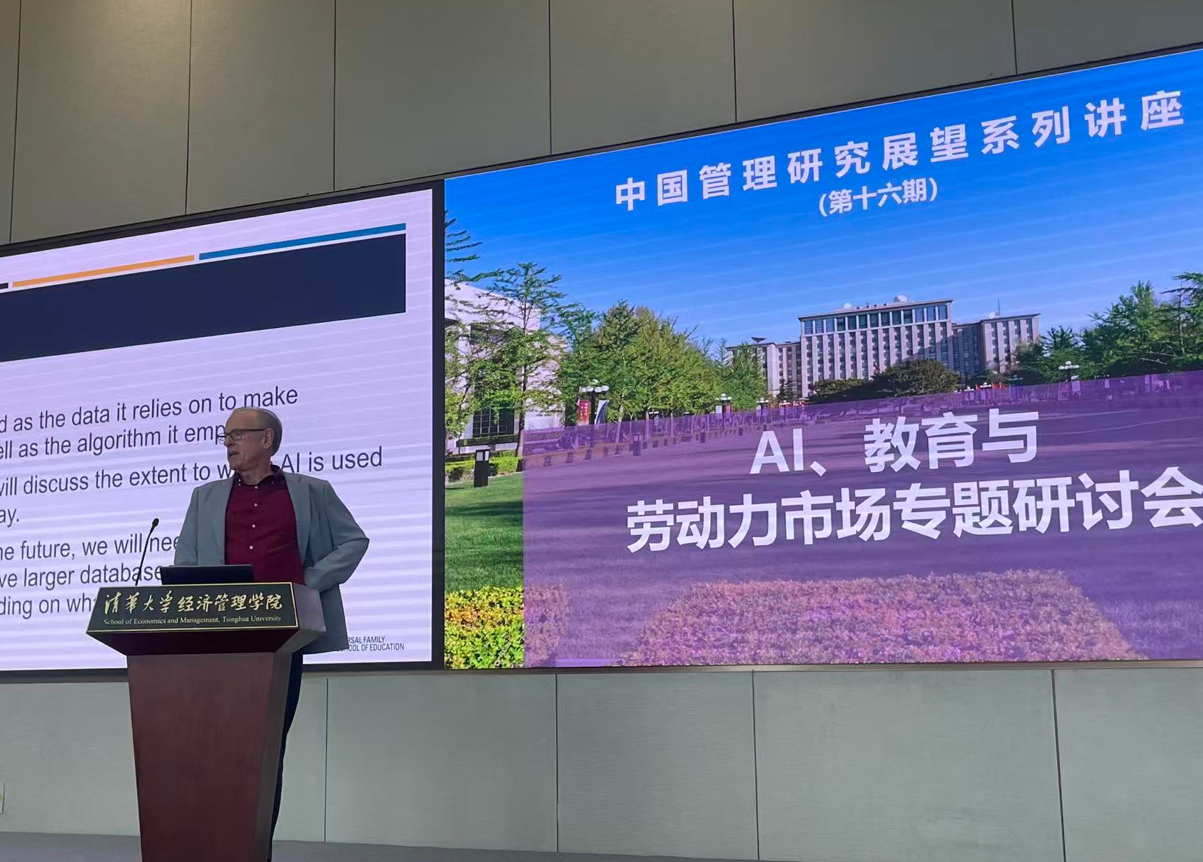
Brian McCall speaks at the seminar on artificial intelligence, education and the labor market, May 21, 2026.
Brian McCall, professor of education, economics and public policy at the University of Michigan, delivered an in-depth presentation on the current state of AI adoption across countries. Drawing on multiple enterprise survey datasets, including the US Census Bureau's Business Trends and Outlook Survey, the UK Office for National Statistics' Business Insights and Conditions Survey and the European Union's Eurostat, he showed how firms in the United States, the United Kingdom and the European Union are using AI, as well as the differences in adoption patterns across these regions.
McCall also spoke about developments related to AI education in the United States at both the K–12 and higher education levels. For example, in K–12 education, many states have already established computer science standards and curricula, and the number of students taking AP computer science exams has been growing rapidly. AI-related concepts have been introduced in primary and secondary education. At universities, masters and doctoral programs in AI and data science are also expanding quickly.
In his concluding remarks, McCall noted that while the use of AI is increasing, substantial differences remain across industries and countries. In the United States, although AI concepts have entered K–12 classrooms, there are still significant disparities across states and schools in terms of what is taught and the quality of instruction. At the same time, new AI and data science programs are continuously emerging across US schools and growing rapidly. He emphasized that the further development of AI education and applications will require continued observation and close attention.
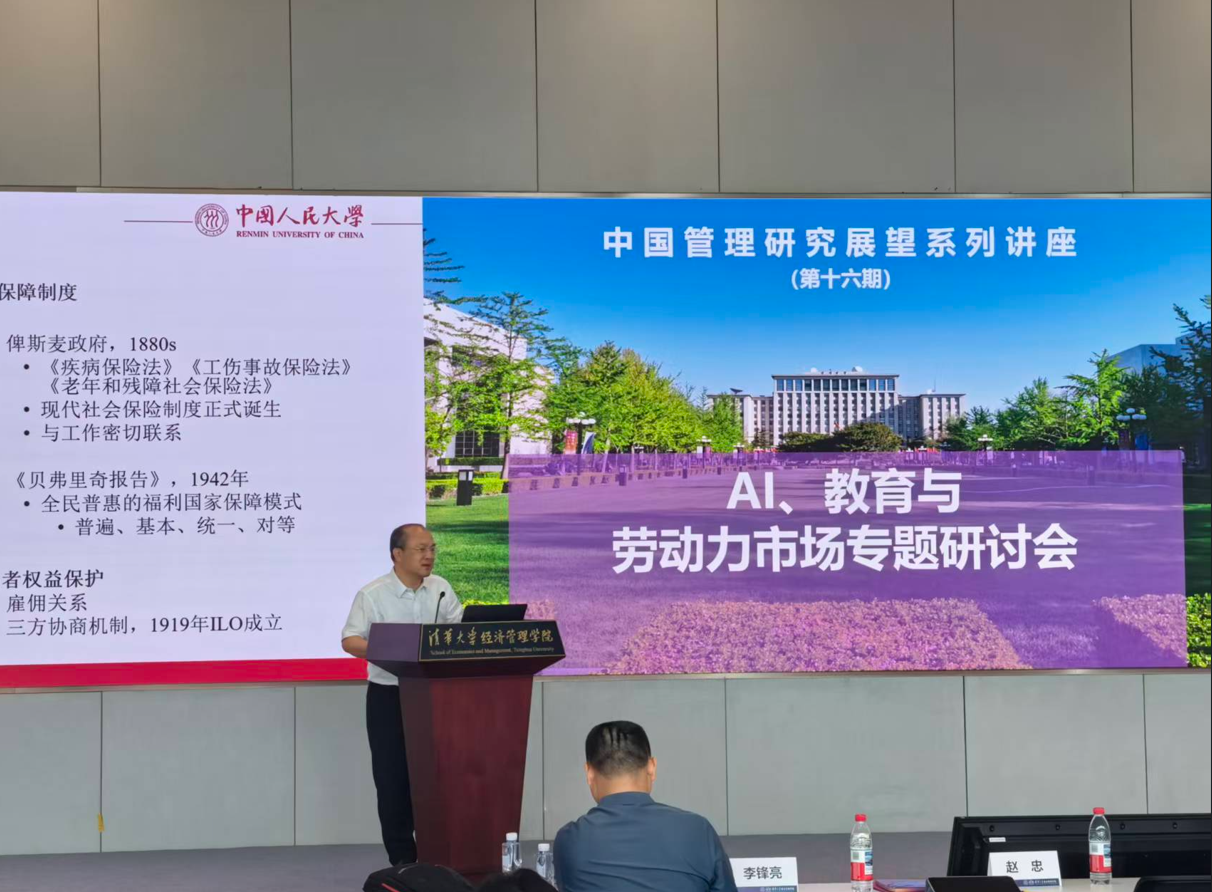
Zhao Zhong speaks at the seminar on artificial intelligence, education and the labor market, May 21, 2026.
Professor Zhao Zhong, dean of the School of Labor and Human Resources at Renmin University of China, delivered a lecture titled "Artificial Intelligence and Labor Market Policies in China." He first pointed out that technological change is profoundly reshaping labor supply and demand: from household production in agricultural society, to full-time employment in enterprises and factories in industrial society, and further to a potentially more socialized, platform-based model of work in the future. Accordingly, he said, the institutional system of the labor market will inevitably be restructured.
Zhao contended that in the traditional context of enterprises, factories and companies, full-time employment, labor contracts, and the arrangements of rights and obligations formed around labor relations constitute the core foundation of labor market institutions, but under a more socialized platform-based model in the future, new forms of employment such as platform work and flexible employment will become increasingly common, requiring corresponding adjustments to the existing labor market institutional system. At the micro level, he said, one of the important changes brought about by artificial intelligence is that work organization will gradually shift from a job-based model to a task-based model of human–AI collaboration. At the macro level, he added, the emergence of new forms of employment also requires labor policies and social security policies to move beyond the traditional model centered on full-time employment and labor contract, and to adapt to platform-based work, socialized employment and new forms of employment.
In terms of workers' skill upgrading and human capital development, Zhao noted that in the AI era, there will no longer be such a clear boundary between learning in school and on-the-job training, and lifelong learning will become essential. In the area of income distribution, he added, new institutional innovations are also needed in response to the profound changes brought by AI, such as exploring arrangements including universal shareholding and sovereign wealth funds. At the same time, he argued that on the public expenditure side, greater support should be provided to workers in response to the frequent skill upgrading and continuous learning needs brought about by artificial intelligence. Within this overall framework, Zhao discussed a series of important issues related to platform work management, labor protection and related areas.
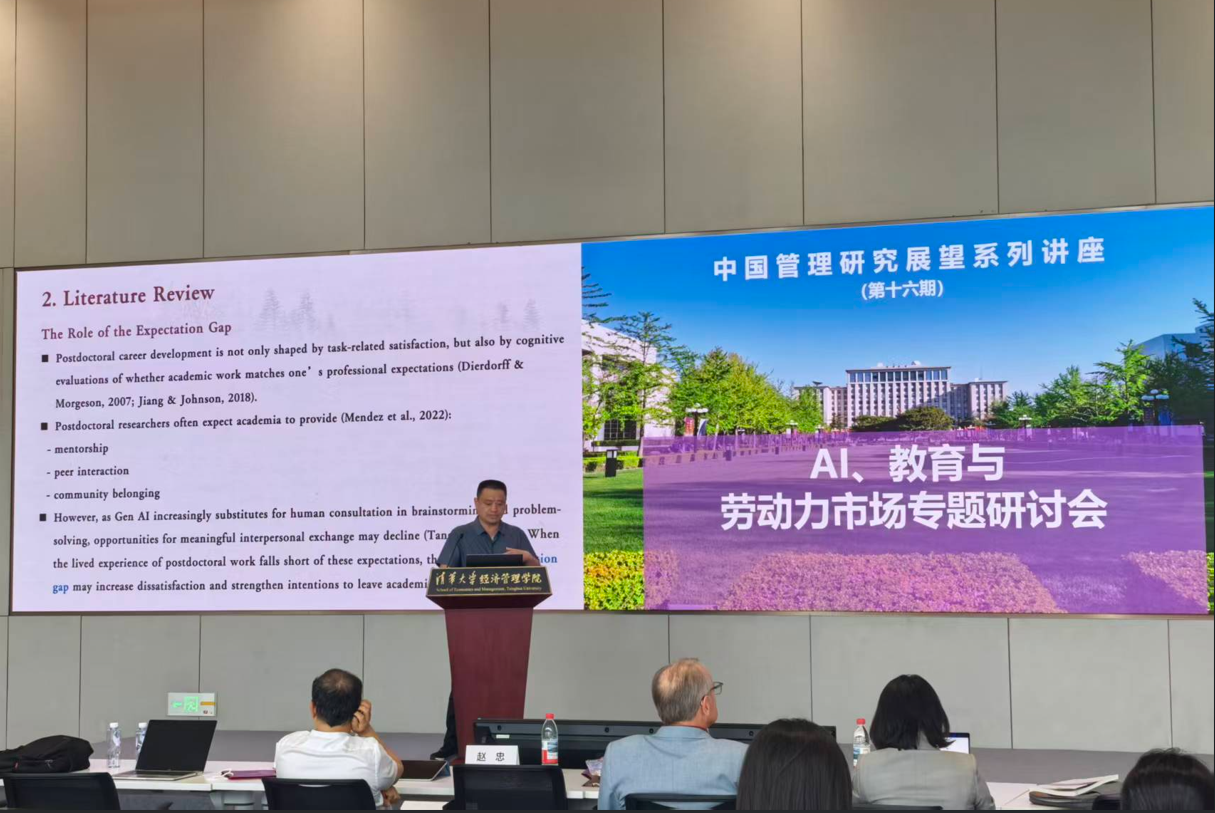
Li Fengliang speaks at the seminar on artificial intelligence, education and the labor market, May 21, 2026.
Professor Li Fengliang from the School of Education at Tsinghua University shared his research based on postdoctoral survey data from Nature, focusing on how the emergence of generative artificial intelligence affects postdoctoral researchers' willingness to continue pursuing academic careers. Overall, his research indicates that, after controlling for other factors, the emergence of generative AI reduces postdoctoral researchers' willingness to continue in academic career. This effect operates mainly through two mediating channels. On one hand, generative AI lowers postdoctoral researchers' sense of work accomplishment in scientific research, on the other, it further weakens their willingness to remain in academia by widening the expectation gap. However, his research also finds that this negative effect is not equally pronounced in all contexts; rather, it is more concentrated in organizational environments where researchers receive lower levels of financial support and less psychological support. In other words, if the organization in which researchers work can provide stronger financial security and psychological support, the negative effects brought about by generative AI will not be equally significant.
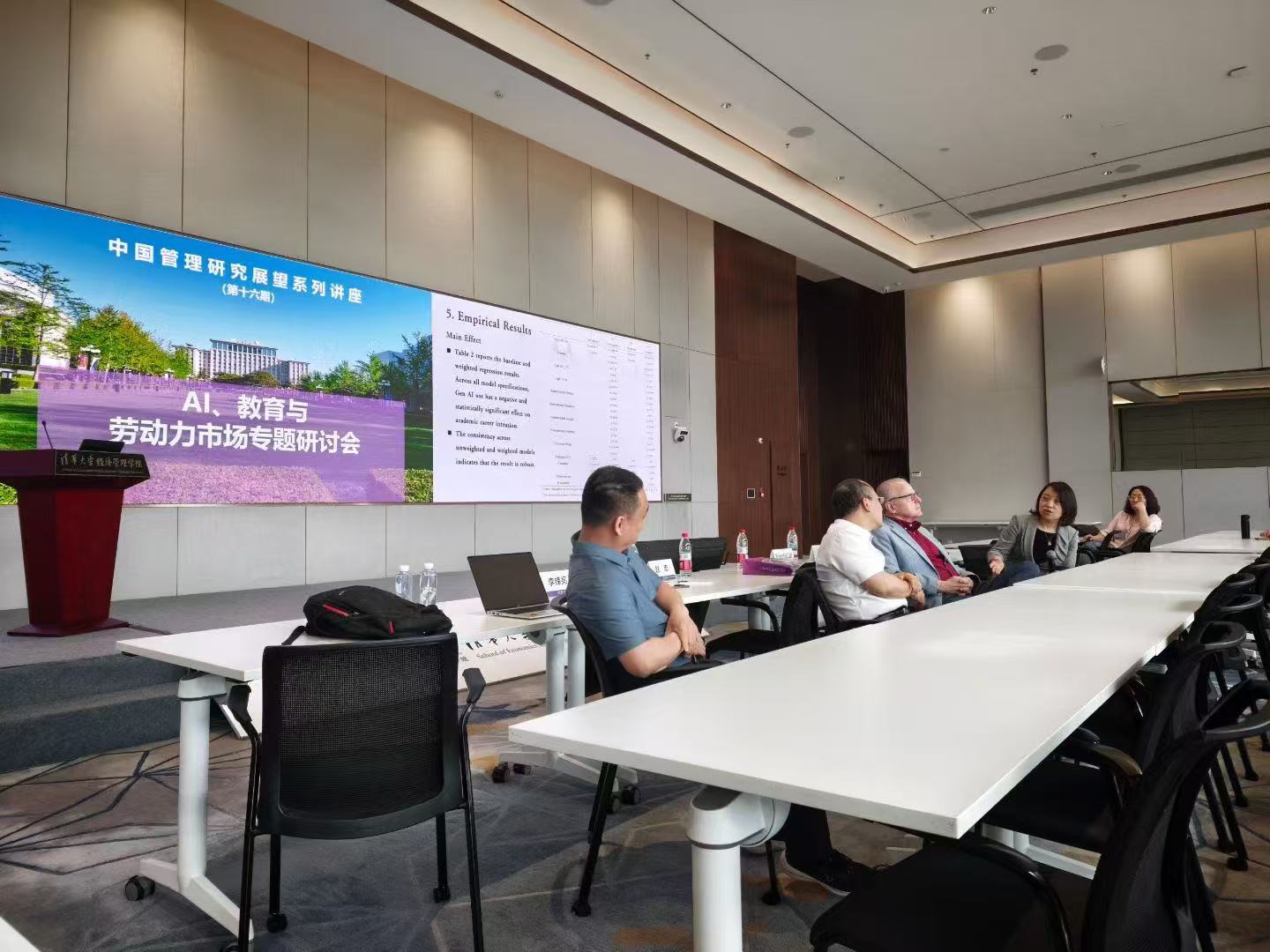
The speakers discuss topics on artificial intelligence, education and the labor market, May 21, 2026.
The speakers later engaged in an in-depth panel discussion, moderated by Professor Chi Wei from Tsinghua SEM, around two core questions: What does generative artificial intelligence mean for higher education and for college students’ future employment, and how should students prepare themselves for this new era?
Professor McCall noted that many skill-based and operational tasks that used to be carried out primarily by humans – such as data analysis and writing – are likely to be increasingly handled by AI. As a result, he said, students need to place greater emphasis on developing their creativity and critical thinking abilities and need to learn how to ask good questions and determine which tasks should be delegated to AI, rather than focusing only on the operational level. He also pointed out that the gap in academic achievement among students may widen in the future: Those who are more creative, have many innovative ideas and are capable of working effectively with AI to implement these ideas, may achieve even more than before.
McCall also discussed the implications for teaching. He observed that using AI to complete homework assignments has become almost unavoidable, so teachers need to repeatedly emphasize that AI can support learning, facilitate interaction and broaden thinking, but it should not replace students' own thinking. Otherwise, he warned, their genuine capacity for independent thinking may be weakened. At the same time, he suggested that assessment methods should be adjusted by reducing the weight of take-home work and increasing the weight of in-class exams. In this way, even if students use AI to assist with some assignments outside class, their actual mastery of knowledge and skills will still become evident in classroom examinations.
Professor Zhao discussed human resource (HR) management education in the context of artificial intelligence. He noted that many operational tasks in future HR functions, such as creating tables and organizing information, may indeed be replaced by artificial intelligence. Therefore, the focus of future human resource management education should shift more toward helping students understand the strategic work of HR, encouraging them to think about what HR should do, what directions HR should grasp, and how to direct and use AI from a higher-level perspective. At the same time, he emphasized that regardless of how technology changes, issues such as talent acquisition, talent development and talent incentivizing will always exist. Therefore, HR work itself will not disappear; rather, in the AI era, it will move toward higher-level and more strategic content.
Regarding the second question – how labor and social protection policies may evolve in the age of AI – the speakers also shared their perspectives. McCall explained that in the United States, the current unemployment insurance and Social Security systems do not cover the self-employed and primarily protect salaried employees. In the AI era, however, more flexible work arrangements, self-employment and independent contracting are likely to become increasingly common. In this context, one of the major practical challenges facing these workers is how to smooth income transitions between jobs, projects and tasks. Given that personal saving rates tend to be relatively low in the US context, he suggested that more mechanisms will be needed to encourage people to better manage income between jobs, and also save and plan for retirement.
Zhao pointed out that China is already adopting measures related to new forms of employment and flexible employment. For example, flexible workers can be included in medical insurance and pension insurance, while broader pilot programs are underway for their work injury protection. As forms of employment further evolve in the AI era, he said, further adaptations will be made in this direction in order to better meet the needs of future labor protection.
During the open discussion session, participants engaged in lively exchanges with the speakers on topics such as employment practices in Chinese and American companies, changes in university education and employment trends in the AI era. For example, one participant asked whether some American companies had truly begun to reduce the hiring of college graduates and instead directly hire high school graduates, and whether such a phenomenon was widespread. These questions prompted extensive discussion among the participants and speakers.

 Latest News