A seminar focusing on the internationalization paths of Chinese enterprises amid the changing global environment, the high-level opening-up strategy, and the construction of an international rule of law system was held at Tsinghua University on April 13, 2026.
The seminar, themed "Current International Economic and Trade Landscape and Supporting Corporate Global Expansion" featured in-depth discussions on issues such as the adjustment of the global economic and trade pattern, the reconstruction of international economic and trade rules, and the theory and practice of enterprises' overseas development.
Hosted by Tsinghua University's School of Economics and Management (Tsinghua SEM) and Tsinghua University's Institute for Global Development, the seminar was chaired by Bai Chong-En, dean of Tsinghua SEM and distinguished professor of Arts and Humanities at Tsinghua University.
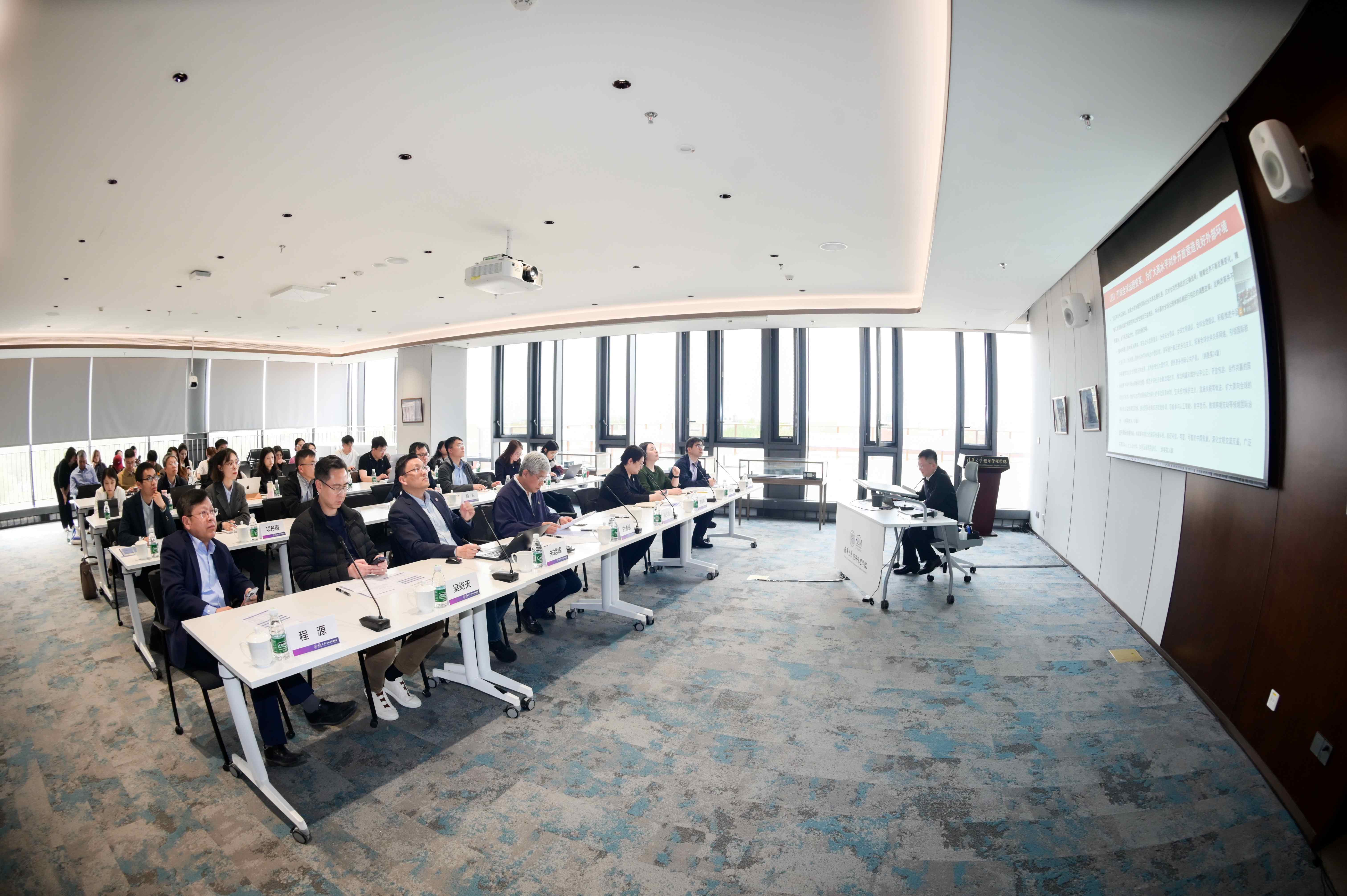
Participants in the seminar
Nie Wenhui, vice chairman of the China Council for the Promotion of International Trade (CCPIT), attended the seminar and delivered a report entitled "Promoting Higher-standard Opening-Up." He systematically sorted out the latest central authorities' arrangements on opening-up, elaborated on China's top-level design and development achievements of high-standard opening-up, and conducted an in-depth analysis of the current international situation. He pointed out that global protectionism is on the rise, while trade barriers and economic and trade frictions are increasing, and enterprises are facing growing compliance pressures in overseas operations. He also comprehensively introduced the CCPIT's practices in such fields as promoting trade and investment, advancing international industrial cooperation, participating in global economic governance, improving services for enterprises going global, and strengthening foreign-related legal services.
Professor Zheng Ruohua, adjunct professor at Tsinghua University School of Law, co-director of the International Arbitration Program, and secretary-general of the Hong Kong International Mediation Centre, emphasized the important role of mediation in international dispute resolution in combination with the responsibilities of the Hong Kong International Mediation Centre. She introduced the basic attributes and core values of the Hong Kong International Mediation Centre, pointed out that it provides opportunities for developing countries to participate in the formulation of international rules, and distinguished the differences between mediation and arbitration to highlight the advantages of mediation.
Professor Zhu Xufeng, dean of the School of Public Policy and Management at Tsinghua University, analyzed the evolution trend of the current global political pattern and the domestic and international dual circulation. He talked about the traditional advantages of foreign markets and the current changes in the global pattern, pointing out that China needs to take the initiative to develop new markets to create favorable conditions for the development of dual circulation.
Professor Ma Hong, chair of the Department of Economics at Tsinghua SEM, focused on building a strong trade country, analyzed the new situation and new drivers facing China's foreign trade. The professor pointed out that in the future, it will be necessary to promote digital trade and green trade, rely on China’s own manufacturing advantages, make up for the shortcomings in service trade, and realize the integration of trade and investment and a risk-controllable global layout.
Professor Cheng Yuan, chair of the Department of Innovation, Entrepreneurship and Strategy at Tsinghua SEM, focused on enterprises' overseas development in the new stage of globalization, explained the necessity, problems and countermeasures of enterprises going global, and emphasized that enterprises need to choose appropriate paths based on their own advantages, guard against various macro risks and make good response measures.
Yang Guohua, professor of Tsinghua University School of Law and executive vice president of the Chinese Society of World Trade Organization (WTO) Law, shared his thoughts and prospects on the future of the multilateral trading system from the perspective of the 14th Ministerial Conference of WTO. He emphasized the importance of the WTO, called for promoting its reform, and adhering to a pragmatic and flexible development direction.
Bai Chong-En remarked that the seminar featured substantial content and expressed gratitude to CCPIT Vice Chairman Nie Wenhui for his comprehensive overview of global economic and trade dynamics and briefings on CCPIT's work, as well as participating experts and scholars for their multi-dimensional insights. Such sharing has enhanced understanding of the context, opportunities, challenges and strategies for the globalization of Chinese enterprises. Moving forward, Tsinghua SEM will keep developing high-end exchange platforms to foster in-depth government-industry-university-research integration.
Before the seminar, the CCPIT delegation led by its Vice Chairman Nie Wenhui held a meeting with Tsinghua SEM. Focusing on better aligning with national strategies, the two sides conducted in-depth exchanges on cooperation in research collaboration and talent development.
Source: Institute for Global Development, Tsinghua University
Editor: Ren Zhongxi

 Latest News